This final project called for the integration of skills learned in Illustrator, Photoshop, and After Effects. In addition, we had the liberty to edit a unique sound by clipping different audios from existing videos and reediting them through Audacity.
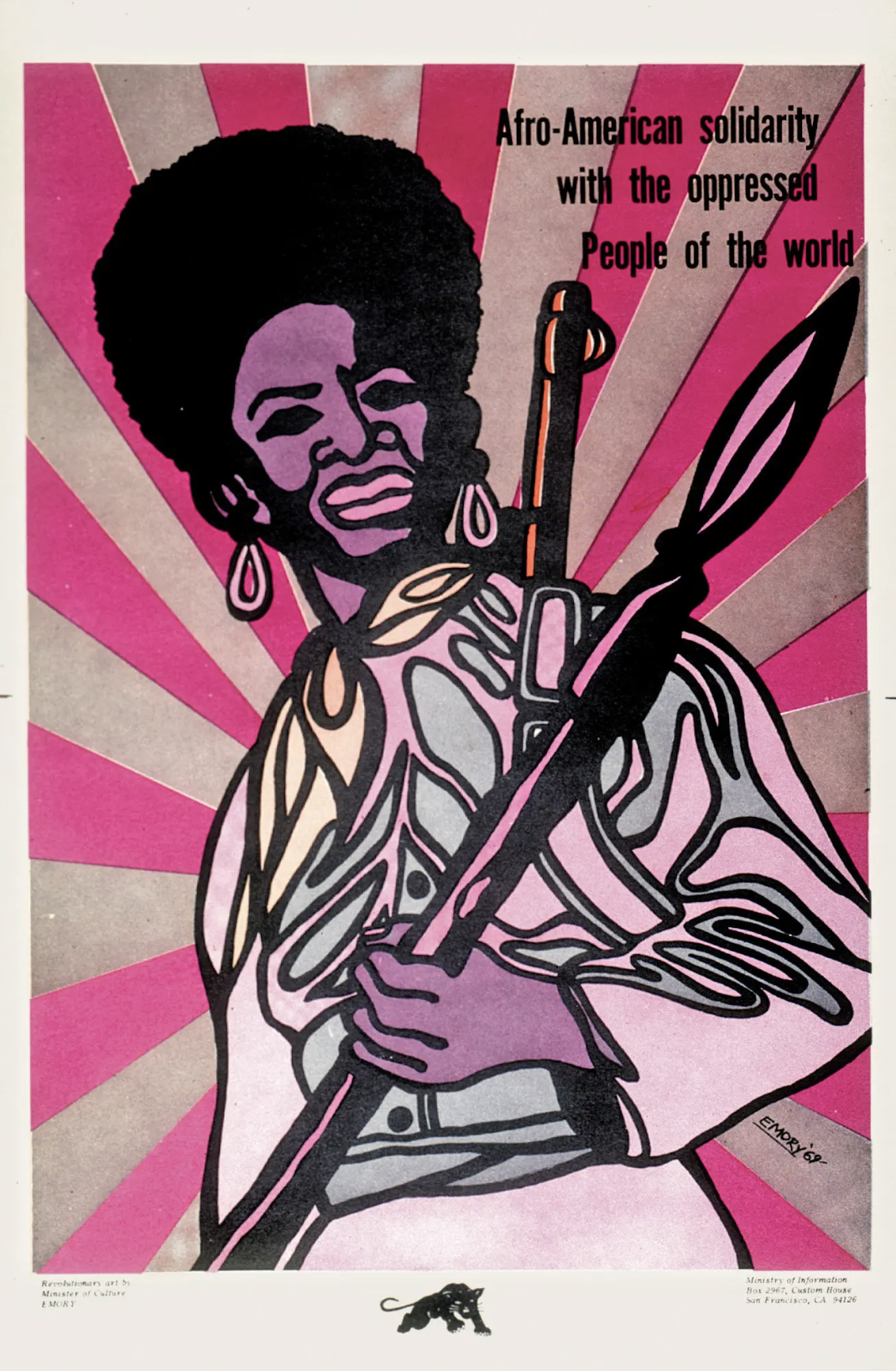
As with any planning process, this project took some time. I came up with two topics that I wanted to document: the Black Panthers and police brutality. I began by looking at art from different artists that depicted the topics separately. However, I soon realized that I could do both by focusing on the Black Panther Movement. I looked at the work of Emory Douglas, a revolutionary artist, who made images for the Black Panthers.[1] He came to join the party when Bobby Seale, the co-founder of the Black Panther Party, discovered Douglas’s work.[2] In his art lecture and discussion with the MoMA, Douglas discloses his production process and inspiration which was exciting to listen to. He mentions that he had a quick turnover as the Panthers needed his pieces for their newspaper. This was reassuring as we also had a short period to produce our animation. In Douglas’s work we see a constant style which he mentions was inspired by Mexican artists working on wood that he loved.[3] However, he had to work with material that was affordable which made him make his art with paper and markers which he says also allowed him to mimic the wood effect with some of his pieces.[4]
As I explored Douglas’s work, I found that I truly loved his selection of colors. While they were vibrant or bold bringing attention to his pieces, he also used plenty of black to balance his pieces. While his work is not animated, they tell a story that is clear and concise. There isn’t a need for his pieces to be animated, but I wonder what he would come to do if he decided to animate his art.
A second artist that I want to bring attention to is Sadie Barnette. She turned her father’s FBI files into art showcasing the long trail of surveillance that was enacted on him and those he was in contact with. She tells Vogue,
“I’m showing something that already exists and asking the viewer to look at it in a different way. The glitter and the spray paint, that represents my generation: graffiti, resistance. But it’s also about a father-daughter relationship. I’m a daddy’s girl, looking at the government looking at my daddy.”[5]
She is transforming the manner we see these files through her perspective rather than one of the agency’s point of view.
While there were countless more artist that I looked at, these two artists were the most prominent sources of inspiration. Once I had my topic, I knew that I had to find an audio to follow my ideas. Therefore, I decided to make my own. The sound that is present in my final comes from the combination of the trailer Judas and the Black Messiah directed by Warner Bros. and from The Black Panthers: Vanguard of the Revolution, a Documentary on the 60s Civil Rights Group by Nelson Stanley.[6] While the complete audio of each of the videos is not used, listening to the entire audio provided clarity to the experiences of the Panthers in order to depict their experiences as best as I could. Stanley’s video takes on a documentary approach where he shares the news and public perspective on the Panthers. He also makes sure to include the perspective and voices of the members of the party. The members speak upon them organizing to protect their community and provide resources not provided to them.[7] The news sources, however, depict them as bandits. As for the trailer, it provided a quick recap of the perspective of law enforcement and the Panthers. While it is less based on providing all information, it captures the essence of the art I was trying to make.
When putting my animation together, I found that adding direct documents found within the FBI’s data system on the Panthers was important as well as the wanted posters found within the Smithsonian’s collection.[8] I included them because they hold power. They share the direct actions by the FBI on this group.[9] The audience is given the opportunity to understand why law enforcement were referred to as pigs. Law enforcement targeted the Panthers. They were watched constantly, they were met with violence and corruption, and were left unprotected as they were criminalized.
With this said, this is what I put together:
[1] “Emory Douglas: Art and Revolution, a Live Discussion | MoMA,” The Museum of Modern Art, accessed April 28, 2022, https://www.moma.org/calendar/events/7290.
[2] Angelica McKinley and Giovanni Russonello, “Fifty Years Later, Black Panthers’ Art Still Resonates – The New York Times,” accessed April 28, 2022, https://www.nytimes.com/2016/10/16/arts/fifty-years-later-black-panthers-art-still-resonates.html.
[3] “Emory Douglas.”
[4] “Emory Douglas.”
[5] Rebecca Bengal, “‘Do Not Destroy’ Is Sadie Barnette Transforming Her Black Panther Father’s FBI Files Into Art | Vogue,” accessed April 28, 2022, https://www.vogue.com/article/sadie-barnette-artist-interview-rodney-barnette-black-panther-fbi-file.
[6] Warner Bros. Pictures, Judas and the Black Messiah – Trailer 2, 2021, https://www.youtube.com/watch?v=6ivHf4ODMi4.
[7] Stanley Nelson, “The Black Panthers: Vanguard of the Revolution,” a Documentary on the 60s Civil Rights Group, 2015, https://www.youtube.com/watch?v=h91Gq9Z9-1s.
[8] Smithsonian, “FBI Wanted Poster for Leroy Eldridge Cleaver,” National Museum of African American History and Culture, accessed April 28, 2022, https://nmaahc.si.edu/object/nmaahc_2011.117.12?destination=/explore/collection/search%3Fedan_q%3DFBI%2520black%2520panther%2520wanted%2520posters&page%3D0.
[9] Federal Bureau of Investigation, “Huey Percy Newton Part 01 of 09,” File, FBI, accessed April 28, 2022, https://vault.fbi.gov/huey-percy-newton/Huey%20Percy%20Newton%20Part%2001%20of%2009.
Bibliography
Angelica McKinley and Giovanni Russonello. “Fifty Years Later, Black Panthers’ Art Still Resonates – The New York Times.” Accessed April 28, 2022. https://www.nytimes.com/2016/10/16/arts/fifty-years-later-black-panthers-art-still-resonates.html.
This article by the New York Times introduces the artist Emory Douglas as well as shares the meaning behind to his art based on the issues that the Party was confronting.
The Museum of Modern Art. “Emory Douglas: Art and Revolution, a Live Discussion | MoMA.” Accessed April 28, 2022. https://www.moma.org/calendar/events/7290.
This article introduces Emory Douglas art within the Black Panther Movement. It shares the video attached to the post that discusses his various pieces, historical content, and his artistic choices.
Federal Bureau Of Investigation. “Huey Percy Newton Part 01 of 09.” File. FBI. Accessed April 28, 2022. https://vault.fbi.gov/huey-percy-newton/Huey%20Percy%20Newton%20Part%2001%20of%2009.
This is the FBI’s database of their COINTELPRO operation on the Black Panther Party and their members. This file is specifically on Huey P. Newton. It shows the agency’s knowledge on his location, meetings, and future travels.
“Most Wanted — FBI.” Folder. Accessed April 28, 2022. https://www.fbi.gov/investigate/organized-crime/most-wanted.
This is the database of the FBI’s most wanted individuals. It taught me how to properly read the posters by seeing patterns on different people.
Rebecca Bengal. “‘Do Not Destroy’ Is Sadie Barnette Transforming Her Black Panther Father’s FBI Files Into Art | Vogue.” Accessed April 28, 2022. https://www.vogue.com/article/sadie-barnette-artist-interview-rodney-barnette-black-panther-fbi-file.
This source introduces the art of Barnette. She shares her father’s FBI files by applying spray paint and gems. She comes to push her audience to see the files from her perspective instead of the agency’s.
Smithsonian. “FBI Wanted Poster for Angela Davis.” National Museum of African American History and Culture. Accessed April 28, 2022. https://nmaahc.si.edu/object/nmaahc_2012.60.8.
This was used as an image source showcasing the FBI’s involvement to surveil and capture Angela Davis. It brings in historical context to the manner that law enforcement agencies were attempting to control the party by targeting members.
Smithsonian. “FBI Wanted Poster for Leroy Eldridge Cleaver.” National Museum of African American History and Culture. Accessed April 28, 2022. https://nmaahc.si.edu/object/nmaahc_2011.117.12?destination=/explore/collection/search%3Fedan_q%3DFBI%2520black%2520panther%2520wanted%2520posters&page%3D0.
This was used as an image source showcasing the FBI’s involvement to surveil and capture Leroy Eldridge Cleaver.
Stanley Nelson. “The Black Panthers: Vanguard of the Revolution,” a Documentary on the 60s Civil Rights Group, 2015. https://www.youtube.com/watch?v=h91Gq9Z9-1s.
This video as that of the Warner Bros. was used as part of my video audio. In addition, this video gave me a better understanding of the history of the Black Panther Party. It included the voices of law enforcement agencies as that of the Panthers.
Verso. “Stokely Carmichael: The Black Power Movement and ‘the Savagery of White America.’” Versobooks.com. Accessed April 28, 2022. https://www.versobooks.com/blogs/2122-stokely-carmichael-the-black-power-movement-and-the-savagery-of-white-america.
This article provides a similar historical understanding of the Black Panthers as that of the video by Nelson Stanley. It shares the programs and purpose that rose from the party as well as the issues they had to confront.
Warner Bros. Pictures. JUDAS AND THE BLACK MESSIAH – Trailer 2, 2021. https://www.youtube.com/watch?v=6ivHf4ODMi4.
I used this specific trailer from the film as it provided a quick transition of perspectives that could be shortened further to fit the time frame of my project. In addition, it gave a proper sense of where my stylized frames should go.

Leave a Reply