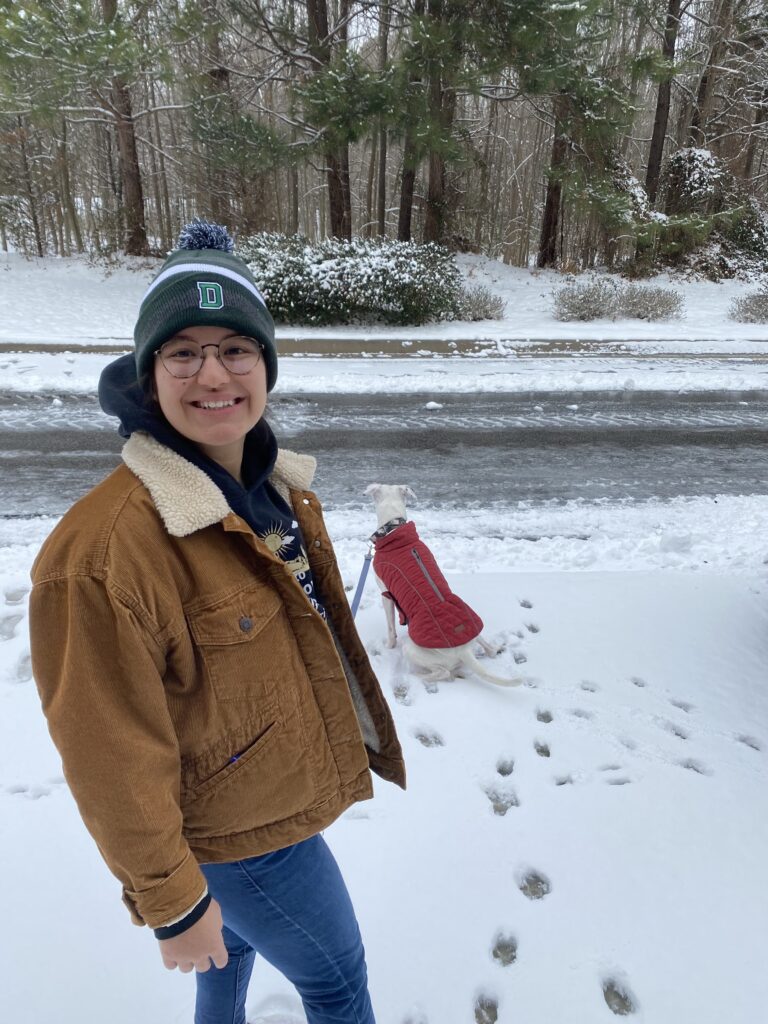
Our first project included exploring and learning the boundaries of Adobe Illustrator through the creation of a self-portrait. The idea of creating a self-portrait with a new program was terrifying. One, I didn’t have previous exposure to the software. Two, I did not know how I wanted to represent myself to the world. I started by scrolling through photographs that brought me joy and showed who I was. Therefore, I came to pick a photo from my winter break. It is a casual photo that speaks upon a memory I have. It’s not something that was taken with the intention of being uploaded to any social media. I think this is important to discuss because as Ashley Strickland discusses in her article the distinction between passing as real and acknowledging that you are making another piece of art by editing is an essential distinction.[1] It is just me being me. I started with a rough sketch of this image which I then transferred to Illustrator to begin my process. However, this picture only showed the superficial parts of me.
(Jan 22, 2022)
Therefore, I wanted the piece to bring attention to my dual identity as a first-generation Mexican-American woman. This struggle of understanding where I stand within a society is difficult as you are considered neither American nor Mexican while simultaneously holding both identities. Defining your identity even with a simple term such as Latinx comes with exploration within the United States that is how you come to assimilate with the culture while holding on to your ethnic roots.[2] Therefore, this was a prominent piece that I wanted to explore and found Ramiro Gomez a Mexican-American man who also feels the same identity issues. In an interview with PBS he says,
“I’m an American-born child to Mexican immigrants. So, I’m at once Mexican and American. I’m in between. That in-between space, that in-between place that I occupy is something that is constantly changing within myself.”[3]
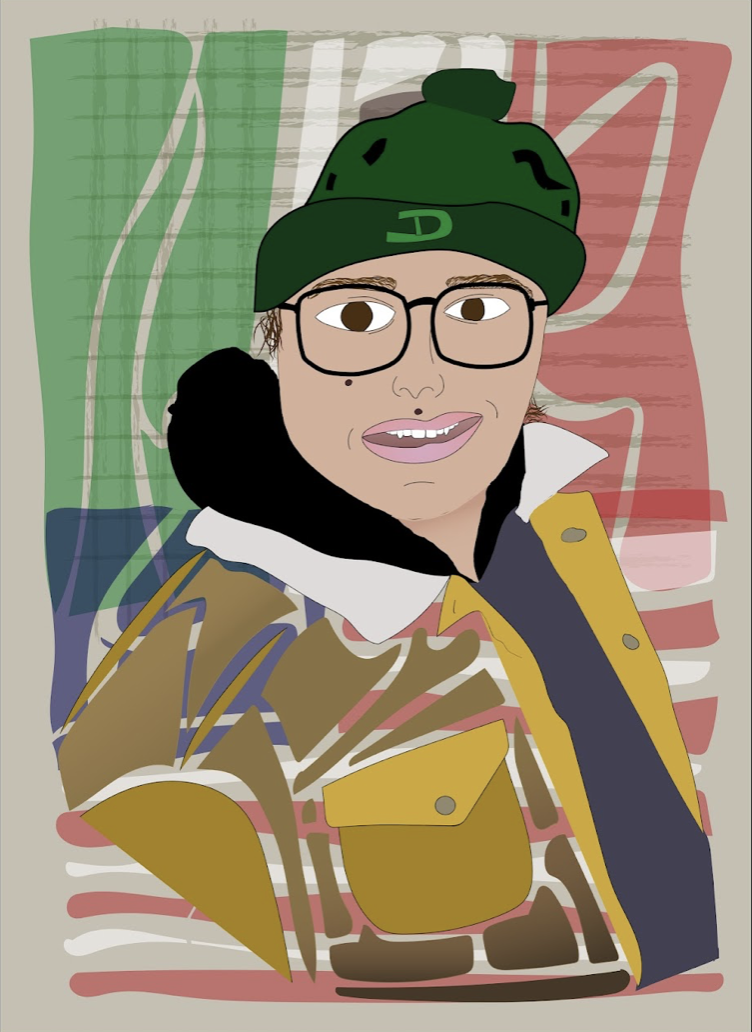
Another Latinx artist that I came to be inspired by was Rosa Rolanda and her 1952 self-portrait. Her portrait speaks upon the turbulent societal navigation she had with her ethnicity, race, and marriage.[4] She represents this by the floating objects that surround the figure she painted of herself. I appreciated that her piece kept her figure intact because it wasn’t that she was the issue or that she was broken but that she was dealing with these aspects of her life that were difficult but still contributed to who she was. This is inferred by the objects come to touch the woman demonstrating the connection this figure has with complicated background. Thus, my piece took a similar approach of having the background showcase parts of me which I’m sorting out while having by body just be me. This piece speaks upon the ongoing struggles of identity regardless of the focus it receives from media.[5] It has not dissipated. With this said, this is how I came to represent myself.
Bibliography
Cotter, Holland. “‘As We Were Saying’: ‘Art and Identity in the Age of “Post.”’” The New York Times, October 2, 2014, sec. Arts. https://www.nytimes.com/2014/10/03/arts/design/as-we-were-saying-art-and-identity-in-the-age-of-post.html.
This article speaks upon the politics of identity and its social implementations regarding what is trending at the moment. He poses that while conversations regarding identity may fade away those impacted by it continue to hold that struggle and conversation.
PBS. “Artists Illuminate Latino Identity and Life in the American West.” PBS NewsHour, March 20, 2017. https://www.pbs.org/newshour/show/artists-illuminate-latino-identity-life-american-west.
The Denver Art Museum held an exhibition called “Mi Tierra” that included the works of 13 Mexican-American artists that explored the concept of place and home. Ramiro Gomez, one of thirteen artists, creates pieces that speak upon his parents’ labor and contributions to his current position as an artist. In addition, he speaks upon the in-between space that he exists within as Mexican-American man.
Alchetron.com. “Rosa Rolanda – Alchetron, The Free Social Encyclopedia,” August 18, 2017. https://alchetron.com/Rosa-Rolanda.
The mixture of text and video in this source brings awareness to Rolanda’s self-portrait and execution. She toggles within sharing the societal pressures she faces while creating a portrait on the way she sees herself.
Strickland, Ashley. “Art Photography: When ‘Reality Isn’t Good Enough.’” CNN, August 10, 2012. https://www.cnn.com/2012/08/10/living/fine-art-photography-manipulation/index.html.This piece discusses the divide between real and edited, but it does not shame the edited images that exist. It rather pushes us to see these pieces as a new artistic creation that began as an unedited piece of art.
[1] Ashley Strickland, “Art Photography: When ‘Reality Isn’t Good Enough,’” CNN, August 10, 2012, https://www.cnn.com/2012/08/10/living/fine-art-photography-manipulation/index.html
[2] Tanzina Vega, “What Does It Mean to Be Latino in America Today?,” CNN, May 6, 2016, https://www.cnn.com/2016/05/06/living/latino-identity-america/index.html.
[3] PBS, “Artists Illuminate Latino Identity and Life in the American West,” PBS NewsHour, March 20, 2017, https://www.pbs.org/newshour/show/artists-illuminate-latino-identity-life-american-west.
[4] “Rosa Rolanda – Alchetron, The Free Social Encyclopedia,” Alchetron.com, August 18, 2017, https://alchetron.com/Rosa-Rolanda.
[5] Holland Cotter, “‘As We Were Saying’: ‘Art and Identity in the Age of “Post,”’” The New York Times, October 2, 2014, sec. Arts, https://www.nytimes.com/2014/10/03/arts/design/as-we-were-saying-art-and-identity-in-the-age-of-post.html.

Leave a Reply